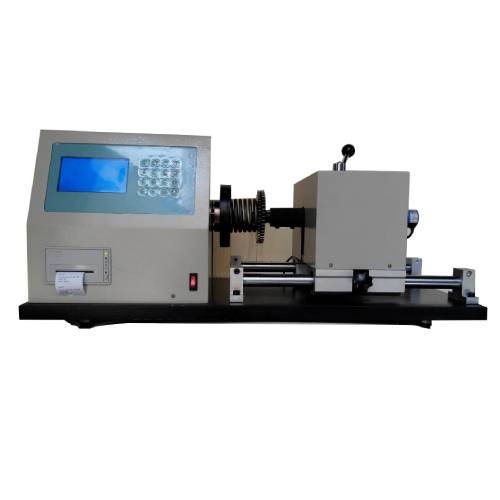
About Keyboard Key Life Testing Machine
Application
(1) Life cycle testing of mobile phone keys, MP3/MP4 buttons, computer keyboards, and electronic dictionary keys.
(2) Durability testing for remote control buttons and silicone rubber keys.
(3) Verification of mechanical switches, tap switches, and film switches.
(4) Multi-point testing on each key to simulate real-world usage.
(5) Research and development for new key materials and designs.
(6) Quality control in electronic and consumer device manufacturing.
(7) Testing under varying key pressures and stroke heights to replicate user behavior.
(8) Comparative testing for different key types and configurations.
Standards
(1) GB/T 4967-95 Silicone rubber and keypad life testing.
(2) Equivalent JIS and IEC standards for key life and durability testing.
Parameters
| Parameter |
Specification |
| Number of test stations |
4. 5. or 8 |
| Test load |
0500g (adjustable or specified) |
| Test stroke |
060mm |
| Test speed |
560 times/min |
| Power supply |
AC 220V 3A (or specified) |
| Control |
Individual control for each test head |
| Drive mechanism |
Motor-driven eccentric |
| Applicable key types |
Mechanical switches, tap switches, film switches, silicone rubber keys |
Advanced Key Life Cycle TestingThis machine supports rigorous life cycle testing of both mechanical and membrane keyboard keys, meeting the demands of quality assurance and product development. Its programmable stroke length and speed enable comprehensive evaluation of key robustness. The digital counter and LED display ensure clear, precise data collection for reliable results.
User-Friendly and Safe OperationDesigned with a manual control panel, adjustable components, and an emergency stop, this testing equipment puts user safety and convenience first. Tabletop mounting and easy specimen installation minimize setup time, making it ideal for laboratory and factory environments.
Customizable, Efficient, and QuietWith low operational noise levels (< 60 dB) and customizable test heads, the machine fits seamlessly into production or R&D workflows. Its semi-automatic operation and simultaneous multi-key testing capability accelerate testing cycles, increasing throughput without compromising accuracy.
FAQ's of Keyboard Key Life Testing Machine:
Q: How does the machine test keyboard key lifespan?
A: The machine simulates repeated key presses using stepper motor-driven actuators, testing each key's durability over a programmable number of cycles. Users can adjust parameters such as stroke length, pressing speed, and the number of test cycles to match specific requirements.
Q: What types of keyboards are suitable for this testing machine?
A: This equipment is compatible with both mechanical and membrane keyboards. It features adjustable fixtures and mounting suitable for standard keyboard keys, allowing flexible use across various keyboard designs.
Q: When should I use the emergency stop button?
A: The emergency stop button should be used immediately if any unsafe condition is detected during operation, such as mechanical failure, specimen misalignment, or as a precaution during equipment maintenance.
Q: Where can the Keyboard Key Life Testing Machine be installed?
A: This tabletop device is suitable for laboratory benches, quality inspection departments, and R&D facilities. Its compact size (530 x 400 x 420 mm) and moderate weight (approx. 35 kg) make it convenient for most professional environments.
Q: What benefits does programmable stroke and speed adjustment provide?
A: Programmable stroke (5-15 mm) and speed (10-60 times/min) settings allow users to replicate various real-world usage scenarios. This versatility ensures comprehensive and realistic life cycle testing of keyboard keys.
Q: How do I reset the electronic cycle counter?
A: The cycle counter can be reset directly via the manual control panel, enabling users to immediately start a new testing session with accurate cycle tracking.
Q: What is the process for mounting specimens and customizing the test setup?
A: Keys are easily mounted onto the stainless steel fixture, with manual adjustments for stroke and width. The machine supports simultaneous testing of eight keys as standard, with optional customization up to sixteen, offering efficient, parallel testing.




 Send Inquiry


 Send Inquiry
