About Mechanical Scratch Tester
Application
Primary test purposes
Coating scratch resistance evaluation
Coating hardness assessment based on mechanical damage behavior
Determination of coating failure load
Detection of coating breakthrough on conductive substrates
Typical tested materials
Painted metal panels
Industrial coatings
Automotive coatings
Protective and functional coatings on metal substrates
Laboratory standard test panels
Standards
(1) GB/T 23989-2009 Determination of scratch resistance of coatings
(2) GB/T 5210-2006 Paints and varnishes Pull-off adhesion test
(3) GB/T 1768-2006 Determination of abrasion resistance of paint films
(4) ISO 1518-1 Paints and varnishes Scratch test Part 1: Determination of scratch resistance
(5) ISO 20502 Coating materials Scratch test
(6) ASTM C1624 Standard test method for adhesion and scratch resistance of ceramic and hard coatings
(7) DIN EN 1071-3 Advanced technical ceramics Mechanical properties of ceramic coatings Part 3: Scratch testing
Parameters
| Parameter |
Specification |
| Stylus moving speed |
35 mm/s |
| Maximum panel size |
100 150 1.6 mm |
| Maximum coating thickness |
0.3 mm |
| Applicable standard setting |
ISO 1518-1 |
| Standard test load |
20 N |
| Power supply |
230 VAC, 50 Hz |
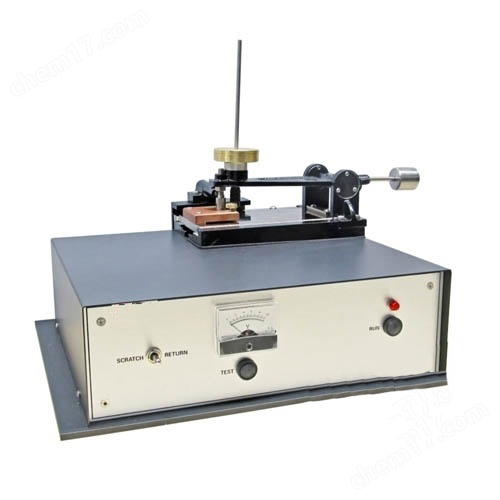
Precise and Flexible Scratch TestingOur Mechanical Scratch Tester offers flexibility with adjustable load, interchangeable stylus options (tungsten carbide or steel), and a compact benchtop design. Suitable for various specimen sizes, it allows laboratories and manufacturers to perform accurate scratch, adhesion, and abrasion resistance tests under controlled conditions. Its manual interface ensures direct handling and full procedural oversight, giving you confidence in each test result.
Compliant and Reliable MeasurementsDesigned in accordance with ISO 1518 and ASTM D7027, this scratch tester guarantees industry-standard test procedures. Its analog gauge provides immediate feedback, with high resolution and accuracy for dependable data. Adjustable clamps firmly hold samples, while the customizable capacity ensures suitability for a range of research and quality control applications. Depend on this tester for consistent performance in demanding laboratory environments.
FAQ's of Mechanical Scratch Tester:
Q: How does the Mechanical Scratch Tester operate for material testing?
A: The tester works by applying a constant, adjustable mechanical load through an interchangeable stylus (tungsten carbide or steel) on the sample surface in a linear motion. The specimen is securely clamped, and the device records scratches under varying loads, enabling detailed analysis of adhesion, scratch, and abrasion resistance.
Q: What is the process for sample preparation and mounting?
A: Prepare your specimen to fit the maximum allowed size (up to 120 mm 50 mm). Place the sample in the adjustable clamps, ensuring it is secured properly for effective and reliable testing. The clamping system accommodates varying sample shapes within the specified dimensions.
Q: When should I use this scratch tester instead of automated models?
A: This manual scratch tester is ideal for environments where precise, hands-on control is required, such as laboratory research and quality control. It offers full procedural oversight, making it suitable for customizing test parameters or handling specialty materials not compatible with full automation.
Q: What types of tests can be performed with this equipment?
A: The device is designed for adhesion, scratch, and abrasion resistance testing according to ISO 1518 and ASTM D7027. It measures how materials respond to mechanical stress under a range of loads, providing valuable data on surface durability and coating quality.
Q: Where is this tester commonly utilized?
A: It is widely used in research laboratories, paint and coating industries, quality control departments, and manufacturing settings where material properties and surface treatments need robust, standardized evaluation.
Q: What benefits does the adjustable stylus and load provide?
A: With interchangeable tungsten carbide or steel stylus and adjustable loads up to 20 N, the device offers great flexibility. Users can adapt testing conditions according to material hardness or specific test requirements, ensuring optimal precision and repeatability for diverse sample types.





 Send Inquiry


 Send Inquiry
