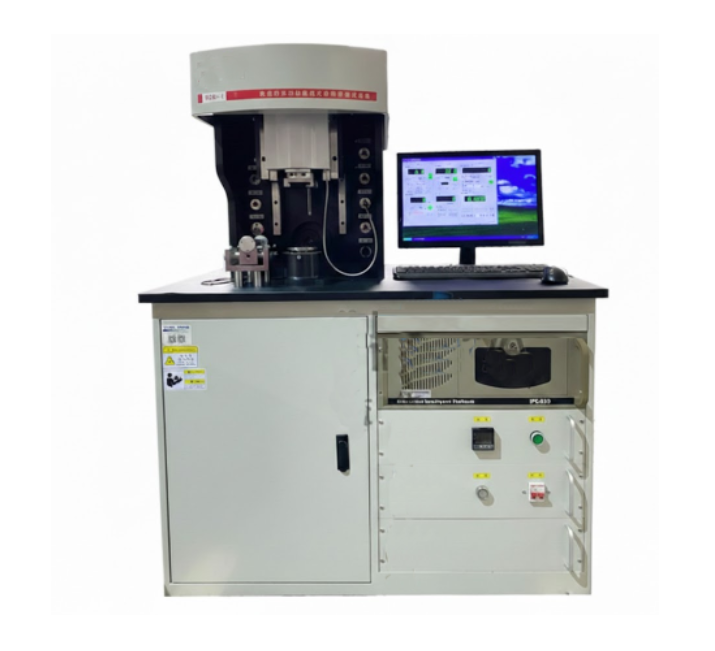
About Multi-Axis Tribometer
Standards
You can perform tests in accordance with:
ASTM G119 Guide for Wear Testing.
ASTM G99 Pin/ball-on-disc friction and wear test.
ASTM G132 Pin-on-disc wear test with indexing function.
DIN 50324 Pin-on-disc friction and wear testing.
Parameters
Base Unit
| Parameter |
Specification |
| Contact Configuration |
Ball-on-flat / Pin-on-flat / Custom samples |
| Normal Load Range |
0.1 100 N |
| Load Measurement |
Strain gauge force sensor |
| Friction Force Range |
0 50 N |
| Friction Measurement |
Strain gauge force sensor |
| Humidity Measurement |
10 90 % RH |
| Drive Motor |
Brushless DC servo, 200 W |
| Loading Actuator |
Linear actuator, 12 V DC, 100 N |
| Indexing Actuator |
Linear actuator, 12 V DC, 100 N |
| Interface |
USB serial interface |
| Control Software |
Proprietary control software |
| Installation |
Benchtop |
| Protection |
Transparent safety shield |
P-Indexed Pin-on-Disc Module
| Parameter |
Specification |
| Contact Configuration |
Ball-on-disc / Pin-on-disc |
| Disc Diameter |
100 mm |
| Track Radius |
0 40 mm |
| Lateral Feed Speed |
10 mm/min |
| Disc Speed |
0 300 rpm |
| Maximum Sliding Velocity |
1 m/s |
R-Indexed Reciprocating Module
| Parameter |
Specification |
| Contact Configuration |
Ball-on-plate / Plate-on-plate / Plate-on-hemisphere |
| Max Reciprocating Velocity |
10 mm/s |
| Max Stroke |
50 mm |
| Max Lateral Velocity |
1 mm/s |
| Max Lateral Travel |
30 mm |
| Temperature Range |
Ambient 100C |
| Dwell Time |
0 8 hours |
| Temperature Sensor |
Type J thermocouple |
| Heating Power |
150 W |
H High-Temperature Non-Indexed Pin-on-Disc Module
| Parameter |
Specification |
| Disc Diameter |
75 mm |
| Track Radius |
0 35 mm |
| Temperature Range |
Ambient 500C |
R/C Cooling Module
| Parameter |
Specification |
| Minimum Temperature |
15C (ambient water cooling) |
| Minimum Temperature |
30C (chiller water/ethylene glycol) |
Versatile Testing CapabilitiesDesigned for comprehensive friction, wear, and lubrication evaluation, this tribometer accommodates a broad range of materials and industrial research needs. With its adjustable load application, programmable motion paths, and specimen compatibility up to 50 mm diameter, it seamlessly adapts to cutting-edge investigations or routine quality checks in research labs. The integrated options for environmental control elevate its utility for simulating real-world conditions.
Precision and RepeatabilityAchieve confidence in your results with friction measurement accuracy of 0.5% of reading and repeatability greater than 98% under identical test conditions. The system maintains low operational noise (<60 dB) and is engineered to deliver consistent outcomes, making it suitable for rigorous scientific study or industrial application. Integrated overload protection and emergency stop features further ensure worry-free operation.
Intuitive Operation and Data ManagementBenefit from either touchscreen or Lab PC control, supported by dedicated Windows software for seamless operation, parameter setup, and data handling. A robust data output via USB or RS232 interface ensures straightforward export and integration into lab workflows. The instrument's ergonomic build and single workstation setup simplify specimen loading and daily operation.
FAQ's of Multi-Axis Tribometer:
Q: How does the Multi-Axis Tribometer ensure precise and repeatable test results?
A: The tribometer features a high-precision measurement system with friction accuracy of 0.5% of reading and repeatability exceeding 98%. Advanced sensors, robust drive mechanisms, and compliance with ASTM G99, DIN 50324, and ISO 20808 standards contribute to consistently reliable results.
Q: What materials and sample sizes can be tested with this instrument?
A: This device is suitable for metals, ceramics, polymers, and coated materials. It accommodates specimens up to 50 mm in diameter, making it ideal for diverse applications in tribology, mechanical engineering, and materials science.
Q: When should I use environmental control features during testing?
A: Environmental control options, such as humidity, temperature, and gas-flow management, should be utilized when simulating real-world operational conditions or conducting experiments where these factors significantly influence tribological performance. The system supports testing from room temperature up to 400C, humidity up to 95% RH, and gas pressures up to 0.5 MPa.
Q: Where does the data from friction and wear tests get exported?
A: Test data can be exported via USB or RS232 interfaces, allowing easy transfer to computers for analysis. The included Windows-based software facilitates seamless data management, report generation, and integration into your laboratory data workflows.
Q: How do I operate and control the tribometer during experiments?
A: Users can control the instrument through an intuitive touchscreen interface or connect to a laboratory PC using the dedicated Windows software. Parameters can be set and monitored in real time, making operation straightforward even for complex test protocols.
Q: What safety features are integrated into the instrument's design?
A: The instrument includes an emergency stop function and overload protection systems, ensuring operator safety and safeguarding equipment during testing. These features minimize risks associated with high-load or high-temperature test scenarios.
Q: What are the main benefits of using this tribometer in research and industrial settings?
A: Key benefits include versatile testing of various materials under controlled environments, high measurement accuracy, easy operation, comprehensive data analysis tools, and robust safety systems. It supports advanced tribological investigations and ensures compliance with major international standards.




 Send Inquiry


 Send Inquiry
