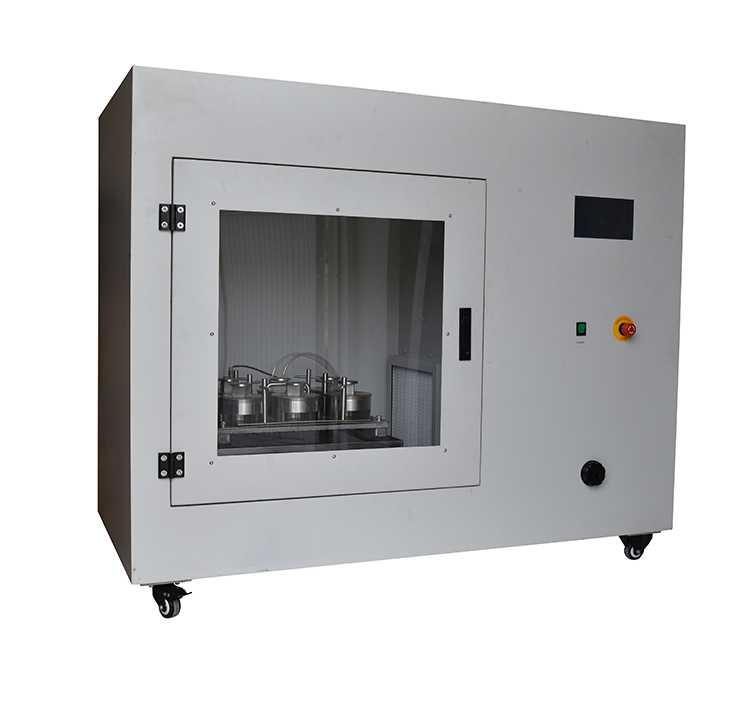
About Textile Fiber Composition Analyzer
Application
(1) Quantitative analysis of fiber content in blended textiles
(2) Identification and separation of natural and synthetic fibers
(3) Quality control in textile manufacturing
(4) Inspection and certification laboratories
(5) Research and development of textile materials
Standards
(1) ASTM D276 Identification of Fibers in Textiles
(2) ISO 1833 Textiles Quantitative Chemical Analysis
(3) AATCC 20A Fiber Analysis: Quantitative
(4) GB/T 2910 Textiles Quantitative Chemical Analysis
Parameters
| Parameter |
Specification |
| Test Method |
Chemical dissolution (modular automated process) |
| Fiber Types |
Natural, synthetic, and blended fibers |
| Measurement Accuracy |
In accordance with ISO 1833 method requirements |
| Sample Weight |
Typically 0.5 5 g (depending on method) |
| Drying Temperature |
Up to 105C (adjustable) |
| Drying Time |
30 min (vacuum drying) |
| Stirring Speed |
0 600 rpm (adjustable) |
| Power Supply |
AC 220V, 50/60 Hz |
| Control System |
PLC + software control |
| Operation Mode |
Fully automatic / semi-automatic |
| Data Output |
Automatic calculation and report generation |
Accurate Fiber Analysis for Textile InnovationExperience unparalleled accuracy in textile fiber identification with a system designed for both industrial and research settings. Supporting magnification from 40X to 1000X, this analyzer can visually inspect and calculate the exact composition of natural and synthetic fibers. Its high-resolution imaging system ensures dependable visual clarity for every test.
Seamless Workflow and Data ManagementEasily export digital images and analysis reports for documentation or further review. The analyzer's advanced software is compatible with Windows 7, 8, and 10, and supports both internal and external data storage, ensuring seamless workflow integration and secure data handling. Connectivity is streamlined with USB 2.0/3.0 ports for rapid data transfer.
Ergonomic Design and Easy OperationDesigned with user experience in mind, the analyzer features a clear LED display and intuitive controls. Offering both manual and automatic image capture, it streamlines your laboratory workflow. Made from high-quality stainless steel and optical components, maintenance is straightforward and the system is easy to clean, making it ideal for busy environments.
FAQ's of Textile Fiber Composition Analyzer:
Q: How does the Textile Fiber Composition Analyzer determine fiber composition?
A: The analyzer employs microscopic visual identification with magnification ranging from 40X to 1000X, combined with advanced image analysis software, to accurately identify and quantify the composition of various textile fibers such as cotton, polyester, wool, and more.
Q: What types of fibers can be tested using this analyzer?
A: This instrument supports testing of both natural and synthetic fiber materials, including cotton, polyester, nylon, wool, and acrylic, making it versatile for textile industry and research applications.
Q: When should I perform calibration, and what methods are available?
A: Calibration should be carried out before initial use and periodically as advised in the manual. The analyzer supports both automatic and manual calibration modes, ensuring accurate and reliable results under different operational conditions.
Q: Where can this analyzer be used effectively?
A: It is suitable for use in textile manufacturing facilities, quality control laboratories, academic research institutions, and export testing agencies, providing comprehensive analysis in settings where accurate fiber identification is critical.
Q: What is the process for analyzing multiple specimens?
A: Up to 10 specimens can be tested in a single session. Users prepare fiber samples (5-20 mm in length), place them on the stage, and follow the software prompts for image capture and analysis, either manually or automatically, with report generation at the end.
Q: What are the key benefits of using this instrument over standard analysis methods?
A: The analyzer offers rapid, non-destructive testing, clear digital documentation, and software-driven composition calculation, resulting in higher accuracy and efficiency compared to conventional manual observation or chemical testing methods.




 Send Inquiry


 Send Inquiry
